Mass Resistance is the Other Side of Large Scale Oppression:
The Reality of the Women’s Liberation Movement in Iran
A speech by Azar Majedi*, given at the International women’s right conference in Dusseldurf, Germany 12-14 October, 2006
In describing women’s conditions in a particular country, one either refers to laws governing that country or statistics which measure women’s status. In this manner, one either exposes the extent of the oppression women suffer or admires their achievements. In regards to women living under the rule of Islam, the situation is pure discrimination and oppression, subjugation and state violence. If women are considered second class citizens in many countries, in countries stricken by political Islam, they are not even considered as citizens. They are only extensions of men. In fact, according to Islam, the concept of citizenry is non-existent. There is a relationship between God and the religious hierarchy and a collective of right-less, conscious-less men, with women as their slaves. As a matter of fact, this is true of any other religion. However, this is beside the point of today’s discussion.
You have heard a great deal about women under Islam, Islam a la Taliban, in Pakistan, in Bangladesh, Somalia, Sudan, and in Iran under the Islamic Republic. The downtrodden situation of women, the sheer discrimination, gender apartheid, Islamic veil, forced marriages, officially recognized pedophilia, (setting the legal age of marriage at 9 for girls), honour killing, polygamy, stoning women to death for engaging in sex outside marriage, encouraging men to hit their wives for punishment. The list is long.
If once the issue of Islam and women was an unknown topic, nowadays, thanks to the rise of political Islam, Islamic states in Iran, Afghanistan, and now in Iraq, it has become a well-known topic. I am sure that you all have heard about the non-existence of women’s rights in Islam. However, some think it is not Islam’s fault, they blame the patriarchy. They maintain that it is not Islam, but patriarchal interpretations of Islam that is responsible for the conditions of women in countries under the rule of Islam. In other words, it is the ruling men’s fault not the ruling Islam. We will not get into the debate that Islam, as with all other religions, is the direct product of a patriarchal era. It could not have escaped being permeated by patriarchic values and outlooks. However, we must state one undeniable fact: which is that millions of women are violated daily by Islamic laws, customs, values and states. We must deal in an effective manner with this violation.
I am here on behalf of the Organization for Women’s Liberation. I am here to familiarize you with realities of Iranian society. You have heard about Iran. I do not mean the oil, or the nuclear project. I do not mean the mullahs or the fatwa against Salman Rushdie. I mean about the situation of women. Today, I want to talk to you about women’s resistance, rather than women’s oppression. You have heard long tales about women’s oppression. I would like to tell you that there is a mass resistance movement against this systematic oppression, this official misogynistic ideology. I would like to share the encouraging news with you that Iran is the birthplace of a very important historic moment in international women’s liberation, a movement more significant than the Suffrage movements, or as vast as the women’s liberation movement in the Soviet Union from 1917 to 1930, or in the West during the 1960s and 1970s. This movement has great potential. If it materializes, it is capable of not only liberating women in Iran, but also opening up the door to freedom to all women of the Middle East. We must recognise this fact. I am here to ask for your solidarity and support.
The situation in Iran is different from that of Afghanistan, Iraq or the Sudan. There is mass discontent in these countries; there is resistance, but there is a lack of a mass movement in defense of women’s rights. Such a movement exists in Iran.
In Iran there has never existed a secular state or the separation of religion from the state and education. The laws have always been religious laws. There has always been a dictatorship. The efforts to reform the family law in favour of women during the 1960s were very meager and not very effective. During the 1979 revolution, a women’s right movement was born. This was not a mass movement, but rather was formed by left and intellectual women. I am from that generation. My struggle for women’s rights and for freedom and equality predates that period.
After the Islamic Republic came to power, they attacked women full-force. In 1979, we organised several March 8 celebrations in Tehran. The society was free from monarchist dictatorship, and we, the women’s rights activists, were celebrating March 8 for the first time. On the same day, Khomeini ordered women to wear the veil. A large demonstration took to the streets in protest to this reactionary order and demanded women’s equality. The protest continued for almost a week, meetings, and a sit-in were organize. Finally the government gave in to women’s demands. A year later women employees were ordered to observe the veil at work, some women protested, hundreds lost their jobs. The first phase of the women’s movement was short-lived. It put up a brave resistance, but it was silenced after two years.
Women’s resistance continued in individualistic fashion, against the veil, gender apartheid and obligatory dress code. Many women have been imprisoned, tortured, flogged, or stoned to death. This brutal oppression was not able to obliterate the spirit of resistance. The new generation reignited this movement on a mass scale and has pushed it forward. Fighting against the Islamic veil and apartheid is one of the main battlegrounds.
When I hear the apologists of the Islamic movement or the defenders of cultural relativism (which, thanks to our relentless struggle has become a marginal tendency) say: “the Islamic veil and apartheid is their culture,” I get furious and want to laugh at the same time. If this is “their culture” then it is supposed that they practice it voluntarily. Why then has this massive means of oppression become necessary? Why are all these special forces formed to deal with cultural disobedience, non-observance of the veil and gender apartheid? I would like to ask-- are these people a bunch of masochists-- who like to practice their culture by being tortured, imprisoned and stoned? What rubbish! The thousands of women who have been tortured, stoned and executed, are the symbol of a vast movement against the Islamic laws, gender apartheid and veil.
I believe there is a straightforward equation: a complex and sophisticated oppressive system only demonstrates that there is a vast and complex resistance to be suppressed. When there are more than one hundred thousand political executions, this bitter and tragic fact reveals that the society does not accept the existing order and wants change.
In Iran, there is a special police force to deal with women, those who protest, those who do not observe the veil and those who challenge the dress code with fashion innovation. This special force was used to crush a demonstration to protest against women’s condition that took place in Tehran in July. Despite all the laws governing dress code and observing the veil, despite prison sentences, fines and flogging, women in Iran ridicule the veil and in their demonstrations have also burned it. The new generation cannot be silenced, cannot be forced back home. This is the resistance I am talking about.
In Iran, there is a vast secular movement for a free and egalitarian society. The women’s liberation movement is one of the main components of this general movement. The de facto status of women is much higher than their official and legal status. In the eyes of the dominant ideology and legislation, women’s status is half of that of men. A woman is the man’s slave. She cannot travel or work without her “master’s” permission, does not have divorce or child custody rights, cannot become a judge or a president. But women in Iran could not be subdued or made to accept this status and image. They want to be whole persons, independent and equal.
I would like to mention a statistical figure: around 66% of entering university students are female. This is in a country where you need to pass difficult entry exams. The competition to get into college is very high. You also have to take into consideration the state’s efforts to push women into the home. Is this statistic accidental? No. This is a trend. Every year this figure has risen, from 30% to 66%. The parliament tried to pass laws to reverse this trend, to prevent women from getting into the university in these high numbers. The representatives of the Islamic parliament argued that this is very detrimental to Islam and the institution of the family. They were alarmed by these statistics. I become overjoyed. This shows a resilient determination on the part of the new generation of women in Iran. This brings hope and shows that women’s liberation in Iran is alive and kicking.
March 8th, International Women’s Day, has become an established tradition in Iran. In the past few years, March 8th has been celebrated in different cities and in different ways throughout Iran. The first time was in 1979 after the collapse of the monarchist regime. This was the birth of a women’s right movement which was silenced after 2 years There was an interruption for several years. In year 2000 a large and open meeting is organized in University of Sharif in Tehran in commemoration of 8 March. The news about small gatherings in different cities have also been spread..
The Islamic Republic tried a propaganda tactic-- it named the birthday of Mohammad’s daughter as the national women’s day. The specialty of this regime has been to suppress movements not only by brutal force, but by means of demagogic propaganda. It crushed the 1979 revolution by calling its state a revolutionary state, its brutal forces the revolutionary guards, and the revolution itself, an Islamic revolution. It disarmed the left by taking over the so-called anti-imperialist movement, by manipulating the anti-American sentiment and taking Americans hostage at the American Embassy. Attempting to substitute the Prophet’s daughter’s birthday for international women’s day was a similar tactic. However, this tactic only worked for a few years. Then it was forced to assign a women’s week. This did not work either. Last year, it was forced to admit defeat and a faction of the regime recognized March 8 as women’s day. March 8th now is an established tradition in Iran. Last year there were many different rallies and meetings organised to commemorate March 8. Some of them, including the one in Tehran, were suppressed. Three months later there was a large protest organised in Tehran to demand reforms in favour of women, several thousand took part. This was also crushed by the wecurity forces and the new special women’s force. Many were arrested and beaten up. A couple of months later a movement was initiated to collect 1 million signatures for changing the laws in women’s favour. The women’s liberation movement is not going to give up or be silenced. The Islamists try to crush it and it rises again even stronger. It seems that all efforts to suppress it, only make it stronger and more resilient.
These are the positive aspects of women’s resistance. Unfortunately, there is a dark and sad dimension to it as well. The number of suicides and setting fire to oneself has increased considerably among women, especially among young women. Women in Iran have always lived under discrimination. Forced marriages, extensive restrictions on their lives, being placed in servitude status vis a vis the men has always been the fact of life for the majority of women in Iran. It seems that at one time they accepted this as a divine and natural law, and resigned themselves to it. However, in the past decade, we are witnessing a significant rise in women’s suicide. This is a protest. The new generation has different expectations and aspirations. Women are not resigned to their “fate.” They want to take their fate into their own hands. When a woman cannot protest collectively, when she cannot direct her anger and disapproval against the state, she directs it against herself. These self-inflicting harms are a means of protest.
It is our duty, it is the responsibility of women’s right activists to transform this method of self-inflicting hurt into a positive resistance. We must change this desperation into hope for change.
Another negative fact is the high number of girls who escape the restrictions and violence in the home in search of freedom and end up in streets. They become homeless, unprotected, and victims of prostitution. They are abused and exploited. Many of these girls wear male clothing, hoping to be freer and less harassed. However, there is no escape. The life of these girls is a telling story of brutality, exploitation and cruelty.
In my opinion, the last two factors are new sociological phenomena in a society that is undergoing profound social, cultural, political and economic changes. Analysis of this situation points us to a massive and deep rooted social resistance against the ruling order, dominant ideology and culture, against the ancient and antiquated values of Islam.
And last but not least, we should mention the diverse cultural and NGO organizations which fight for women’s rights. These organizations must adapt themselves to the suppressive state and laws, but we are witnessing the birth of many different organizations, festivals, and solidarity camps. These are the bright and hopeful aspects of women’s resistance.
My friends, there is a mass resistance movement in Iran against sexual discrimination and for gender equality. This movement needs your solidarity and support. If we succeed in freeing women from oppression and misogynistic laws and values, this will open up a door to all women living in the Middle East and countries under the rule of Islam. We must launch a vast international movement against discrimination, violence and systematic oppression, against gender apartheid and Islamic veil. The Organisation for Women’s Liberation calls upon you to join this movement. We have drawn a resolution against gender apartheid, I ask you to support it. Show your support by applauding and sign our petition. Thank you.
************************************************************
This speech was interrupted many times by audience applause. The resolution was endorsed by heavy applause and hundreds signed the petition during the conference.
*Azar Majedi is a veteran women’s rights activist from Iran. She is also the editor of Medusa a Journal of Women and Socialism, , a broadcaster in New Channel, a satellite TV broadcasting into Iran, Middle East and Europe in Farsi and English, and a leader in the Worker Communist Party of Iran.
Monday, November 06, 2006

Friday, September 22, 2006
Chavez's Shameful Embrace of Ahmadinejad
Chavez’s Shameful Embrace of Iranian President Ahmadinejad:
Show Solidarity with the Women and People of Iran , not their Oppressors!
by Jennifer Fasulo
j4fasulo@yahoo.com
Hugo Chavez, one of the key important figures in the left populist movements spreading throughout Latin America, has publicly lauded and embraced Iranian president Ahmadinejad. See “Two anti-US nations heap praise upon each other.” http://qevjf.ucg.net/2006/WORLD/americas/09/17/venezuela.iran.ap/
It is moments like this, when feminists and any activists who care about women's liberation, are reminded of just how little women’s lives matter in the world of patriarchal nationalist politics.
One expects Chavez to condemn all US war-mongering and threats against Iran . We can applaud as he uses the public stage to denounce Bush as a criminal who is out to dominate and destroy the world. But there is no excuse for declaring solidarity with a misogynist theocrat like Ahmadinejad.
By embracing Ahmadinejad, Chavez is adding steam to the growing and dangerous alliance between left-wing and right-wing anti-imperialism. In this equation, the only thing that matters is one’s opposition to US imperialism. Women’s rights, worker’s rights, student’s rights-- the things that are supposed to matter to socialists and progressives-- be damned.
Apparently, Chavez, appears not to have noticed that the Iranian government has created one of the most brutal and misogynist regimes in modern history—turning Iran into a country where gender apartheid and sexist hatred of women has been enshrined in law, where women are still TODAY stoned to death for the “crime” of adultery, buried up to their necks and pelted in the face and head with stones until they die, where women have no right to divorce or child custody, are legally forced to veil under threat of physical beating or imprisonment, can’t travel without the permission of a husband or father, where their testimony in a court of law is considered half that of a man, and where political dissent of any kind, for women and men, is punishable by imprisonment, often torture and death. This is the government that Chavez compares to his own as a “heroic nation,” one which he deems, “revolutionary.”
Chavez’s lack of concern for women’s rights under Islamic governments is reflective of the male left generally. The issue is not on the radar screen. If it's raised at all, it's often dismissed or excused as an issue of "culture." This insidious use of the word “culture” implies that women are brutally subjected not through force and violence, but because they or their “culture” wants it that way, and therefore it’s okay and nothing to get upset about. This argument, aside from insulting the human spirit, which never passively accepts subjugation, is also profoundly ignorant of the actual conditions and historical facts in Iran . Any cursory investigation of Iranian society will show that the Iranian people are a people in utter revolt against their despotic rulers, with women leading the way. For 27 years women have resisted and defied the Islamic regime’s persecution of them, often at great risk to their lives. Along with an inspiring women’s movement, there are strong, secular workers and student movements, all of them opposing not only the Islamic regime, but also the US threats of military attacks and sanctions on Iran .
How can Chavez, who considers himself a socialist and a defender of the downtrodden, align himself with the leader of such a reactionary regime, rather than the inspiring socialist and feminist movements which are fighting against it? It is a terrible political choice that he need not make. Chavez can and should renounce his solidarity with Ahmadinejad and place it with the people of Iran where it belongs. He should be standing, not by the side of the executioner, but by the side of the unjustly accused and condemned, like 17 year old Nazanine Fatehi who awaits execution for the crime of defending herself and her niece from a gang of rapists. Or Kobra Rahmanpour who also awaits execution and writes in a public letter, “I have suffered enough… Please help me! I don’t want to die. But right now I am more like a lifeless body who has forgot happiness and laughter in the scare from the execution rope… My only hope lies in people and my fellow humans.” (see the International Committee Against Executions, for the full story at http://www.adpi.net/) How must Kobra, and Nazanine feel to see Chavez throw his arms around their excecutioner?
Chavez’s stance needs to be condemned by all progressive forces within the international community. One group that has already issued such a condemnation is the Worker Communist Party of Iran (WPI). In a statement issued on September 14, they write, “We see the attempts by right-wing pro-America forces to overthrow Chavez and we value every bit of positive reform by the Chavez government in the interest of deprived and hungry people, but defending the murderous and terrorist leaders of the Islamic Republic, rolling out the carpet for them under the guise of anti-imperialism is nothing but throwing dust in the eyes of the people and covering up the brutal reality of the Islamic regime.” The WPI goes on to challenge the very notion that the Islamic Republic is an anti-imperialist force. “We must make it clear to Chavez and Castro that the Islamic current, without the support of the US government and western powers, could not have come to power—and without their help could not have stayed in power.”
In these bleak times, many on the left see Chavez as the great hope for the world and are loathe to call into question his commitment to revolutionary politics. Chavez does deserve credit for the things he’s done to improve the lives of poor people and curb the abuses of capitalism in Venezuela . Many feminists have also praised his economic initiatives for women and willingness to recognize the contribution of women’s unpaid labor in the home. Recently, he passed a historic bill which would compensate women for their unpaid housework, something that socialist feminists have been fighting for decades. Yet these facts must also be balanced by other disquieting aspects of Chavez’s politics. He has frequently been criticized for his authoritarian leadership, including by the Venezuelan women who are pushing him to make good on his promises. In a manner disturbingly close to Bush and Ahmadinejad, he likes to claim that he has “god on his side.” After the recall election in which Chavez triumphed over efforts by the opposition to unseat him, he declared, “God has spoken.” And while some feminists have praised him as a champion of women’s rights, others have pointed to his strong anti-abortion stance. He even attempted to create an anti-abortion amendment to the Venezuelan constitution, but strong resistance forced him to back off it . Among feminists, the issue of paying women for housework is also not clear cut. There has long been a debate within feminist circles as to whether this will have a liberating effect (raising women out of poverty) or whether it will further institutionalize women in the role of domestic servitude. All of these issues deserve to be reconsidered in light of Chavez’s alliance with an anti-feminist fundamentalist like Ahmadinejad.
We have to ask ourselves, what hope does Chavez represent, especially for women, if he’s willing to align himself with a government that treats women like sub-humans? What hope do we have if we can't distinguish between revolutionary movements and the forces which seek to destroy them? Precisely because things are so bleak right now and the forces of reaction and religious bigotry are on the rise around the world, we must not tolerate leftist alliances that seek to legitimize them. We must not allow the undermining of the women’s liberation movement in Iran that is tirelessly fighting to save women’s lives and break the chains of their legal imprisonment, nor the progressive revolutionary movements that are charting a third course between US domination and right-wing opposition to it. These are the movements that represent the true hope for the ideals of justice, equality and human liberation. Now, more than ever, we must stand up and defend them.
Show Solidarity with the Women and People of Iran , not their Oppressors!
by Jennifer Fasulo
j4fasulo@yahoo.com
Hugo Chavez, one of the key important figures in the left populist movements spreading throughout Latin America, has publicly lauded and embraced Iranian president Ahmadinejad. See “Two anti-US nations heap praise upon each other.” http://qevjf.ucg.net/2006/WORLD/americas/09/17/venezuela.iran.ap/
It is moments like this, when feminists and any activists who care about women's liberation, are reminded of just how little women’s lives matter in the world of patriarchal nationalist politics.
One expects Chavez to condemn all US war-mongering and threats against Iran . We can applaud as he uses the public stage to denounce Bush as a criminal who is out to dominate and destroy the world. But there is no excuse for declaring solidarity with a misogynist theocrat like Ahmadinejad.
By embracing Ahmadinejad, Chavez is adding steam to the growing and dangerous alliance between left-wing and right-wing anti-imperialism. In this equation, the only thing that matters is one’s opposition to US imperialism. Women’s rights, worker’s rights, student’s rights-- the things that are supposed to matter to socialists and progressives-- be damned.
Apparently, Chavez, appears not to have noticed that the Iranian government has created one of the most brutal and misogynist regimes in modern history—turning Iran into a country where gender apartheid and sexist hatred of women has been enshrined in law, where women are still TODAY stoned to death for the “crime” of adultery, buried up to their necks and pelted in the face and head with stones until they die, where women have no right to divorce or child custody, are legally forced to veil under threat of physical beating or imprisonment, can’t travel without the permission of a husband or father, where their testimony in a court of law is considered half that of a man, and where political dissent of any kind, for women and men, is punishable by imprisonment, often torture and death. This is the government that Chavez compares to his own as a “heroic nation,” one which he deems, “revolutionary.”
Chavez’s lack of concern for women’s rights under Islamic governments is reflective of the male left generally. The issue is not on the radar screen. If it's raised at all, it's often dismissed or excused as an issue of "culture." This insidious use of the word “culture” implies that women are brutally subjected not through force and violence, but because they or their “culture” wants it that way, and therefore it’s okay and nothing to get upset about. This argument, aside from insulting the human spirit, which never passively accepts subjugation, is also profoundly ignorant of the actual conditions and historical facts in Iran . Any cursory investigation of Iranian society will show that the Iranian people are a people in utter revolt against their despotic rulers, with women leading the way. For 27 years women have resisted and defied the Islamic regime’s persecution of them, often at great risk to their lives. Along with an inspiring women’s movement, there are strong, secular workers and student movements, all of them opposing not only the Islamic regime, but also the US threats of military attacks and sanctions on Iran .
How can Chavez, who considers himself a socialist and a defender of the downtrodden, align himself with the leader of such a reactionary regime, rather than the inspiring socialist and feminist movements which are fighting against it? It is a terrible political choice that he need not make. Chavez can and should renounce his solidarity with Ahmadinejad and place it with the people of Iran where it belongs. He should be standing, not by the side of the executioner, but by the side of the unjustly accused and condemned, like 17 year old Nazanine Fatehi who awaits execution for the crime of defending herself and her niece from a gang of rapists. Or Kobra Rahmanpour who also awaits execution and writes in a public letter, “I have suffered enough… Please help me! I don’t want to die. But right now I am more like a lifeless body who has forgot happiness and laughter in the scare from the execution rope… My only hope lies in people and my fellow humans.” (see the International Committee Against Executions, for the full story at http://www.adpi.net/) How must Kobra, and Nazanine feel to see Chavez throw his arms around their excecutioner?
Chavez’s stance needs to be condemned by all progressive forces within the international community. One group that has already issued such a condemnation is the Worker Communist Party of Iran (WPI). In a statement issued on September 14, they write, “We see the attempts by right-wing pro-America forces to overthrow Chavez and we value every bit of positive reform by the Chavez government in the interest of deprived and hungry people, but defending the murderous and terrorist leaders of the Islamic Republic, rolling out the carpet for them under the guise of anti-imperialism is nothing but throwing dust in the eyes of the people and covering up the brutal reality of the Islamic regime.” The WPI goes on to challenge the very notion that the Islamic Republic is an anti-imperialist force. “We must make it clear to Chavez and Castro that the Islamic current, without the support of the US government and western powers, could not have come to power—and without their help could not have stayed in power.”
In these bleak times, many on the left see Chavez as the great hope for the world and are loathe to call into question his commitment to revolutionary politics. Chavez does deserve credit for the things he’s done to improve the lives of poor people and curb the abuses of capitalism in Venezuela . Many feminists have also praised his economic initiatives for women and willingness to recognize the contribution of women’s unpaid labor in the home. Recently, he passed a historic bill which would compensate women for their unpaid housework, something that socialist feminists have been fighting for decades. Yet these facts must also be balanced by other disquieting aspects of Chavez’s politics. He has frequently been criticized for his authoritarian leadership, including by the Venezuelan women who are pushing him to make good on his promises. In a manner disturbingly close to Bush and Ahmadinejad, he likes to claim that he has “god on his side.” After the recall election in which Chavez triumphed over efforts by the opposition to unseat him, he declared, “God has spoken.” And while some feminists have praised him as a champion of women’s rights, others have pointed to his strong anti-abortion stance. He even attempted to create an anti-abortion amendment to the Venezuelan constitution, but strong resistance forced him to back off it . Among feminists, the issue of paying women for housework is also not clear cut. There has long been a debate within feminist circles as to whether this will have a liberating effect (raising women out of poverty) or whether it will further institutionalize women in the role of domestic servitude. All of these issues deserve to be reconsidered in light of Chavez’s alliance with an anti-feminist fundamentalist like Ahmadinejad.
We have to ask ourselves, what hope does Chavez represent, especially for women, if he’s willing to align himself with a government that treats women like sub-humans? What hope do we have if we can't distinguish between revolutionary movements and the forces which seek to destroy them? Precisely because things are so bleak right now and the forces of reaction and religious bigotry are on the rise around the world, we must not tolerate leftist alliances that seek to legitimize them. We must not allow the undermining of the women’s liberation movement in Iran that is tirelessly fighting to save women’s lives and break the chains of their legal imprisonment, nor the progressive revolutionary movements that are charting a third course between US domination and right-wing opposition to it. These are the movements that represent the true hope for the ideals of justice, equality and human liberation. Now, more than ever, we must stand up and defend them.
Wednesday, July 26, 2006
Global Unions Launch UN Complaint Over Iranian Repression
25 July 2006
Global union the ITF and international union body the ICFTU today made a formal complaint against Iran to the ILO (International Labour Organization) following the continued use of terror tactics against one of the ITF’s member unions there.
The union bodies today submitted a dossier detailing coninuing repression against the Syndicate of Workers of Tehran and Suburbs Bus Company (Sherkat-e Vahed) that is not just contrary to all norms of justice and human rights but is in direct contravention of the very principles to which the Islamic Republic of Iran signed up when it joined the ILO.
Since it was set up as an independent trade union in 2005 the Syndicate, which is affiliated to the ITF, has been subjected to an ongoing campaign of harassment, arrests and physical attacks. These include the continuing detention of the union’s President Mansoor Osanloo.
To read the full article please click on the link below:
http://www.itfglobal.org/press-area/index.cfm/pressdetail/878
Global union the ITF and international union body the ICFTU today made a formal complaint against Iran to the ILO (International Labour Organization) following the continued use of terror tactics against one of the ITF’s member unions there.
The union bodies today submitted a dossier detailing coninuing repression against the Syndicate of Workers of Tehran and Suburbs Bus Company (Sherkat-e Vahed) that is not just contrary to all norms of justice and human rights but is in direct contravention of the very principles to which the Islamic Republic of Iran signed up when it joined the ILO.
Since it was set up as an independent trade union in 2005 the Syndicate, which is affiliated to the ITF, has been subjected to an ongoing campaign of harassment, arrests and physical attacks. These include the continuing detention of the union’s President Mansoor Osanloo.
To read the full article please click on the link below:
http://www.itfglobal.org/press-area/index.cfm/pressdetail/878
Monday, July 24, 2006
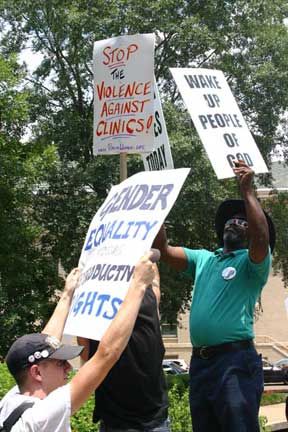
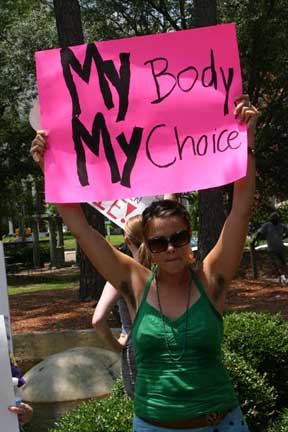
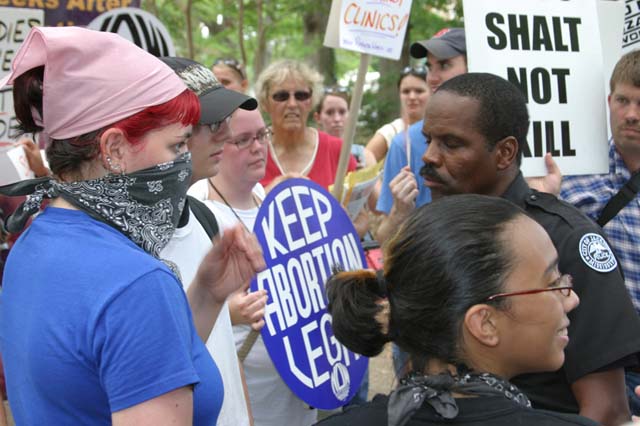
The Joy of Resistance at WBAI Covers the Showdown Between Religious Right and Feminists in Missisippi
By Jennifer Fasulo
July 23, 2006
This Thursday, July 27 at 11am, tune in to The Joy of Resistance, Multi-cultural Feminist Radio to hear an important report about the showdown between the Religious Right and Feminists in Mississippi.
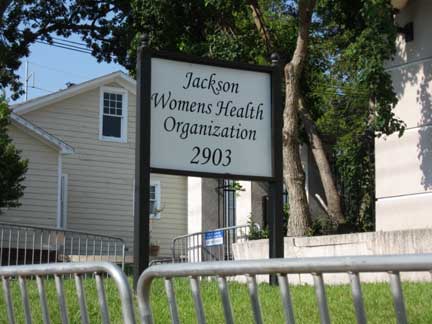
The religious-fascist group “Operation Save America”(OSA), formerly Operation Rescue, descended on Jackson Mississippi for a week of protest activities designed to shut down the last remaining abortion clinic in the state. In response, local feminist groups, such as the Jackson Area National Organization for Women, along with hundreds of feminists and progressives from around the country united to oppose and denounce the Religious Right’s ongoing anti-woman and anti-freedom agenda. According to media reports, Feminists and their supporters outnumbered the religious fanatics by 4 to 1. According to Michelle Colon, President of the Jackson area chapter of the National Organization of Women, not only did “Operation Save America” fail in their goals to shut down the clinic, but their presence helped galvanize local residents and instigate an exciting new grassroots effort, particularly by women of color, to defend women’s rights.
Listen to interviews with Michelle Colon, Jackson NOW president and Betty Maloney of Radical Women in NYC recount the successful week’s activities.
Residents of NY, NJ and CT can hear report on Thursday July 27, at 11am on WBAI 99.5 FM.
Those out of range can listen online by going to www.wbai.org and clicking on live streaming.
After the 27th, it can also be heard by going to the same link, clicking on archives and scrolling down and clicking on the date and time of show.
July 23, 2006
This Thursday, July 27 at 11am, tune in to The Joy of Resistance, Multi-cultural Feminist Radio to hear an important report about the showdown between the Religious Right and Feminists in Mississippi.
The religious-fascist group “Operation Save America”(OSA), formerly Operation Rescue, descended on Jackson Mississippi for a week of protest activities designed to shut down the last remaining abortion clinic in the state. In response, local feminist groups, such as the Jackson Area National Organization for Women, along with hundreds of feminists and progressives from around the country united to oppose and denounce the Religious Right’s ongoing anti-woman and anti-freedom agenda. According to media reports, Feminists and their supporters outnumbered the religious fanatics by 4 to 1. According to Michelle Colon, President of the Jackson area chapter of the National Organization of Women, not only did “Operation Save America” fail in their goals to shut down the clinic, but their presence helped galvanize local residents and instigate an exciting new grassroots effort, particularly by women of color, to defend women’s rights.
Listen to interviews with Michelle Colon, Jackson NOW president and Betty Maloney of Radical Women in NYC recount the successful week’s activities.
Residents of NY, NJ and CT can hear report on Thursday July 27, at 11am on WBAI 99.5 FM.
Those out of range can listen online by going to www.wbai.org and clicking on live streaming.
After the 27th, it can also be heard by going to the same link, clicking on archives and scrolling down and clicking on the date and time of show.




Thursday, June 15, 2006
Cartoon: Islamic Femal Police Suppress Women Protesters.
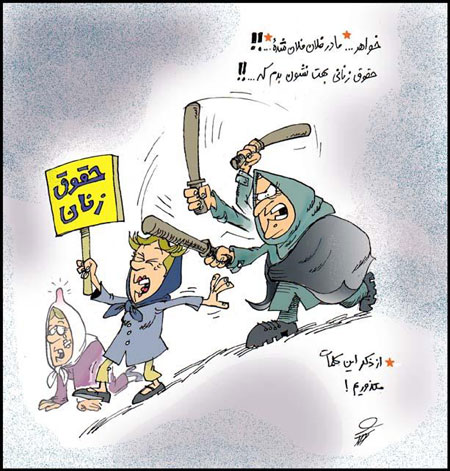
Translation:
"Womens Rights" (Sign)
"Your sister is a [b]...*, mother [f]...!!*" (first line, top right)
"I will show you what women's freedom means!!" (second line, top right)
"*Unfortunately we cannot mention these words." (bottom right)
Human Rights Watch Condemns Assault on Women's Protest in Tehran
Iran: Police Assault Women’s Rights Demonstrators
(New York, June 15, 2006) – Iran must investigate the police beating of hundreds of women’s rights activists during a peaceful demonstration in Tehran on Monday, Human Rights Watch said today. The organization called on the government to release those detained after the police attack on protestors.
Eyewitnesses told Human Rights Watch that police and intelligence agents lined Haft Tir Square in downtown Tehran hours before the start of the planned demonstration on June 12. As the demonstrators assembled, the security forces immediately started to beat them with batons, sprayed them with pepper gas, marked the demonstrators with color spray, and took scores into custody.
“The Iranian government has again shown its utter contempt for basic freedoms like the right to peaceful assembly,” said Sarah Leah Whitson, director of Middle East and North Africa division at Human Rights Watch. “The authorities should free those arrested at once and find out who’s behind the police violence.”
On Tuesday, Jamal Karimirad, a spokesman for the Judiciary, confirmed that security forces arrested 70 people, 42 women and 28 men, to prevent the demonstration from taking place. He said the Judiciary is charging the detainees with “participation in an illegal assembly.”
An eyewitness told Human Rights Watch that, for what is thought to be the first time, the government transported policewomen to the demonstration to arrest female demonstrators while policemen dealt with male protestors.
“Female police officers ruthlessly beat demonstrators with their batons and took many into police vans for detention,” this witness said. “Bystanders were shocked at how harshly the police reacted to demonstrators.”
Full text at: http://www.hrw.org/english/docs/2006/06/15/iran13548.htm
(New York, June 15, 2006) – Iran must investigate the police beating of hundreds of women’s rights activists during a peaceful demonstration in Tehran on Monday, Human Rights Watch said today. The organization called on the government to release those detained after the police attack on protestors.
Eyewitnesses told Human Rights Watch that police and intelligence agents lined Haft Tir Square in downtown Tehran hours before the start of the planned demonstration on June 12. As the demonstrators assembled, the security forces immediately started to beat them with batons, sprayed them with pepper gas, marked the demonstrators with color spray, and took scores into custody.
“The Iranian government has again shown its utter contempt for basic freedoms like the right to peaceful assembly,” said Sarah Leah Whitson, director of Middle East and North Africa division at Human Rights Watch. “The authorities should free those arrested at once and find out who’s behind the police violence.”
On Tuesday, Jamal Karimirad, a spokesman for the Judiciary, confirmed that security forces arrested 70 people, 42 women and 28 men, to prevent the demonstration from taking place. He said the Judiciary is charging the detainees with “participation in an illegal assembly.”
An eyewitness told Human Rights Watch that, for what is thought to be the first time, the government transported policewomen to the demonstration to arrest female demonstrators while policemen dealt with male protestors.
“Female police officers ruthlessly beat demonstrators with their batons and took many into police vans for detention,” this witness said. “Bystanders were shocked at how harshly the police reacted to demonstrators.”
Full text at: http://www.hrw.org/english/docs/2006/06/15/iran13548.htm
Women's Protest Brutally Attacked by the Iranian Security Forces
 Women's Protest Brutally Attacked by Iranian Security Forces
by Mahmood Ketabchi
06/14/2006
mekchi@msn.com
Thousands of women and male supporters came together on June 12 in Haft Tir Square in Tehran, Iran to protest against anti-women Islamic laws and gender apartheid. A similar rally was held last year on June 12, where participants declared their determination to follow up their just struggle for equality and women's liberation.
Ever since the Islamic Republic, with its barbarous acts, has imposed its ominous rule on Iranian society, women have occupied the center stage of struggle for freedom and equality. Despite twenty seven years of suppression and the imposition of medieval Islamic laws designed to make women subhuman, women have refused to stay silent. They have resisted the Islamic brutality by any means they could. They have fought for their freedom, that is, the freedom of the entire society.
In Monday's action, women protesters demanded the abrogation of Islamic Sharia laws. According to Islamic laws: 1) men are allowed to have four wives at the same time and as many “temporary wives” as they want, 2) the right to divorce is for men only, 3) women are deprived of child custody, 4) in inheritance, brothers are awarded twice as much as their sisters, 5) women are legally deprived of certain jobs such as being a judge, 6) women's testimony in court only counts for half that of a man, 7) financial punishment for killing a woman is half what it is considered for a man, 8) girls as young as 9 years old can be forced into marriage, 9) women cannot travel outside of the country without the permission of their husband, 10) women must observe Islamic dress codes and are segregated from men, etc.
Several days before the protest, many women's rights activists were harassed by the Islamic regime and summoned by the security forces. They were told that they had to call off the protest, but women refused and vowed to go head with their plan.
As usual, the government controlled media and heavily censored press provided no coverage of women's plan to hold a rally. However, organizers used their independent resources to put together and publicize their event. People came from all over Tehran to show their support for women's rights and indignation toward the Islamic misogynist laws. They brought signs and posters to announce their demands.
Like other women's protests this year, the rally in haft Tir Square became the target of brutal suppression. Islamic security forces, including female police,occupied the location of the protest, hours before it was to begin. They also patrolled the adjacent streets to prevent people from going to the rally. Despite the show of intimidation and force by the police, many people gathered in the square, held up their signs and posters, raised their fists and chanted “we are women, we are human beings, but we have no rights!” Female police, draped in dark veils from head to toe, carried batons and along with other security forces and plain clothed Islamic hooligans attacked and beat up the women protesters. Many protesters were injured. Blood was seen in many parts of the square. Approximately a hundred people were arrested and driven to unknown locations. As the police attacked and savagely beat up protesters, they verbally abused women and insulted them with filthy sexist slurs. They also called the protesters “agents of foreigners and imperialism;” the customary manner in which the Islamic regime attempts to suppress every form of dissent by using such labels. But with utter determination, women continued their protest and were able to walked around the square. Police attacked the rally with pepper gas and dispersed the crowed. As people were forced out of the square, they continued chanting their demands and condemning the police violence and brutality.
Since International Women's Day in March, this was the second largest women's protest in Tehran. On March 8, hundreds of women celebrated by protesting against the Islamic regime and anti-women laws in Iran. That demonstration was also suppressed by the security forces, an act that brought international condemnation against the Islamic government.
The Islamic regime is being encircled by mass protests of workers, students, unemployed youth, and women. The specter of mass rebellion and revolution has always hovered over the the Islamic government in Iran since it came to power in 1979. That is why the Islamic security forces try to crush any protest that can potentially trigger the unstoppable roller-coaster of rebellion.
The masses of people in Iran are lusting for freedom and equality. They have fought and will continue to fight the barbaric Islamic regime to build a better world.
Translation for posters: "The Association to Defend Women" (top right), "We Want Laws Based on Human Rights - The Association to Defend Children's Rights" (top left), and "We Want the Right to Divorce, the Right to Testimony [in court], and All Other Suppressed Rights" (bottom).
Click here to see the pictures of the rally.
Tuesday, June 13, 2006
Pictures from Women Protest in Tehran on June 12
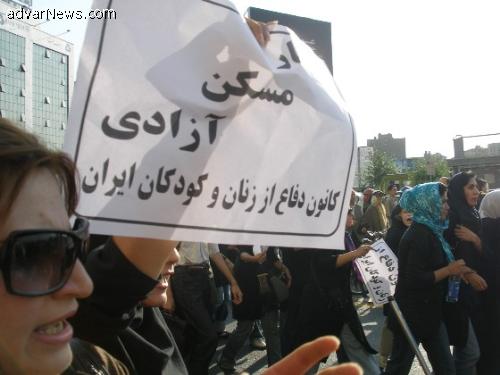 "Work, Housing, and Freedom." Association to Defend Women and Children's Rights in Iran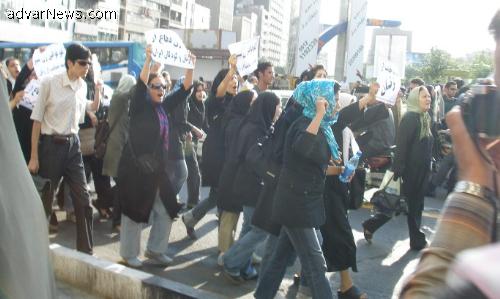
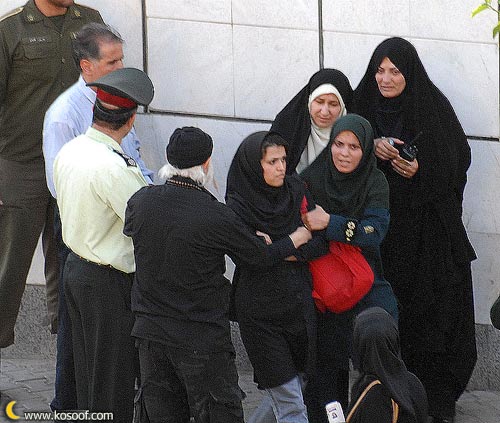
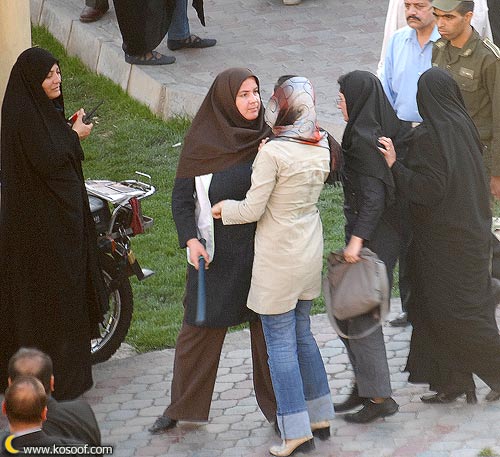

Click here to read the report about the rally.
Saturday, June 03, 2006
Students at Ferdosi University in Mashhad, Iran Support Student Protests in Tehran
 "Students will die but will not accept to be despised"
"No to detentions and arrests"
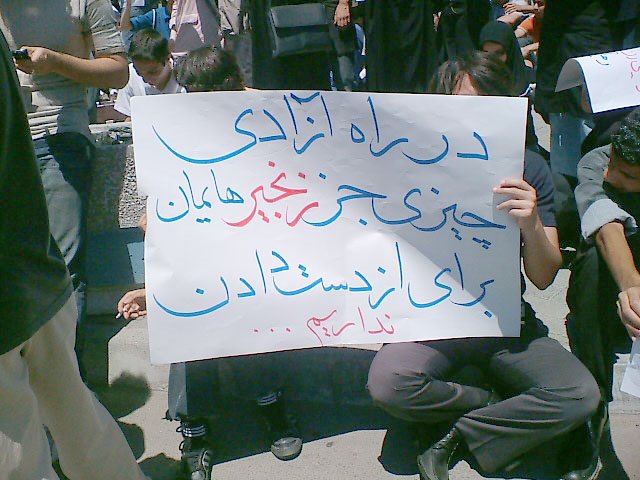 " To obtain freedom, we will lose nothing but our chains"
 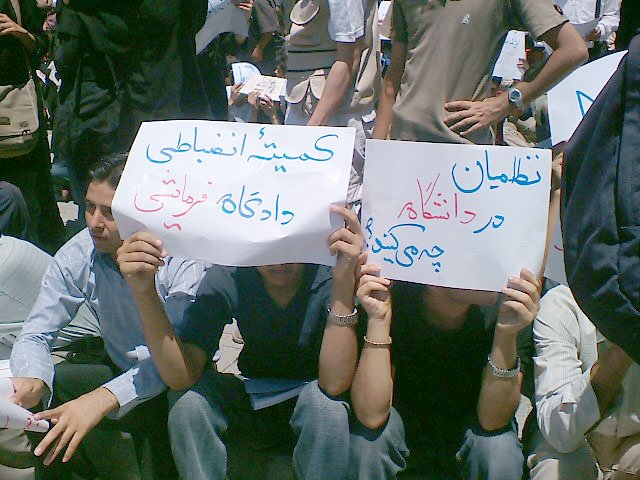 "Why are military personnel in the university?"
"Diciplinary Committee, an imposed 'juctice' "
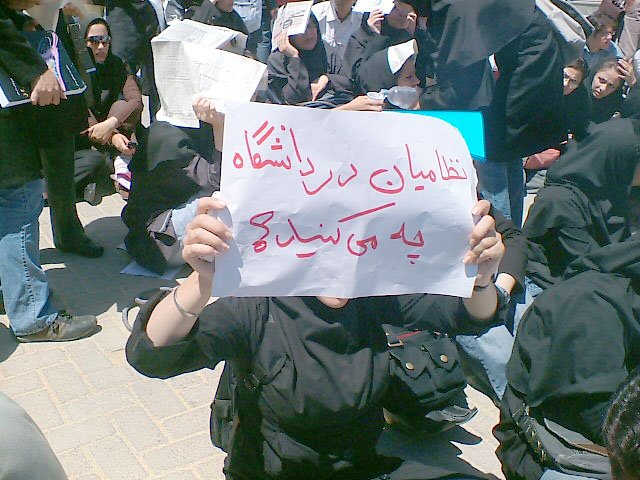 "Why are military personnel in the university?"
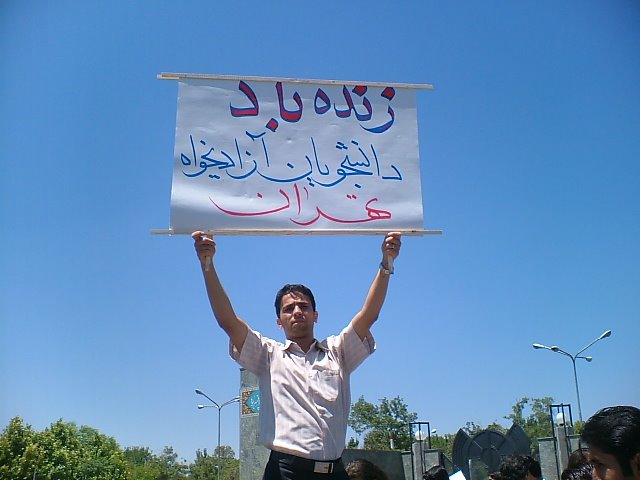 "Long live freedom-loving students in Tehran"
More than 500 students assembled in Ferdosi University in Mashhad to show their solidarity with recent massive student protests in Tehran. In a statement, they declared their support for students' demand in Tehran and strongly condemned the voilent and brutal assualt on student protesters. The statement also said, "There is an increasing threat of war against the Islamic Republic, a war that puts the security and the well-being of our people in great danger. As a result of this war, the economic, social, and civil structures of our society will be in complete risk of collapse, and the society can be embroiled in internal and external wars. In such circumstances, the students in Tehran have posed to the society a different alternative, that is, to struggle to determine the destiny of our country by our own hands, a struggle that has declared freedom and equality as its goals.”
Thursday, May 18, 2006
Rape as Cost of Entry for Female Immigrants
Women's debate show exposes rape
as cost of entry for female immigrants
by Jennifer L Pozner
May 13th, 2006
Posted by Mahmood Ketabchi
From WIMN
As I write this, I'm watching an important segment on "To The Contrary," PBS's weekly women's political and current affairs debateshow, on the underreported issue of sexual assault as an exceptionallyregular aspect of border crossing for women immigrants.
According to T.O.C. host Bonnie Erbe:
"New studies by the United Nations Development Fund for Women showsexual abuse on the rise among women illegally crossing the U.S.border from Mexico. Rape is so common it's viewed as the price ofadmission to America. Some even take birth control before crossing toavoid pregnancy… So-called 'border bandits' prey on those crossing theU.S. Mexican border illegally. Women are more vulnerable because theirpercentages have risen among illegal immigrants. They're also leavingbehind more children in Mexico and Central American countries. If caught and returned, they're often physically abused again in the Mexican border towns where U.S. agents leave them."
To give viewers a deeper understanding of the impact of immigration on undocumented women, Erbe interviewed Marijke Velzeboer-Salcedo, chief, Latin America and the Caribbean section of the U.N. Development Fund for Women, who explained that:
"Between 60 % 70% of women do experience some abuse, of the womenwho cross the border alone (because some of the women do cross the border with their husbands or their families). But many of the women do go alone and we know that among the Mexican non documented
immigrants, 45% are women. And in Guatemala it's 35% and it's rising."
With some exceptions, much immigration coverage in recent months hasfocused on male activists leading protests, undocumented men workingas day laborers, male DJs at Spanish-language radio stations informinglisteners about the importance of attending immigration
demonstrations, and the like. But as this To The Contrary segment illustrates, there are serious reasons why women's perspectives are needed in immigration coverage–and serious ways to frame immigration as specifically relevant to women.
Erbe's opening question to her panelists was a simple query that should be — but hasn't been — a staple in most media coverage of immigration:
"So, what are their [women's] lives like at home that they're willing to try to cross illegally, so many of them die, and now we find 60 to 70% of them are sexually abused and they're taking birth control before they cross the border knowing that they're likely to be raped?"
It's an important question, one posed far too rarely in the recent spate of corporate media coverage of immigration. Unfortunately, the panelists (a Democratic pundit, a Democratic Congresswoman, aRepublican pundit and a spokeswoman from the right-wing anti-feminist Independent Women's Forum) didn't answer it as fully as they should have, steering the debate away from the motivations of women immigrants and toward border patrol and enforcement issues.
Let's hope more mainstream and independent news coverage further explores the stark realities faced by female immigrants in their home countries, in the transition process, and in the United States. When you see stories like this that frame immigration as the women's issue it is, send a thank-you to the station or publication responsible for broadening the debate (you can reach To The Contrary at mailto:atttcviewers@yahoo.com). We'd love you to CC WIMN on your letters: info@wimnonline.org.
Likewise, when immigration coverage leaves women out of the picture,WIMN encourages you to send a letter to the editor asking the newsoutlet to delve deeper. Let media know that women's perspectives canonly expand and strengthen reporting and commentary on immigrationissues–and that no reporting that leaves women out of this story can be complete or wholly accurate. Again, feel free to copy WIMN on your letters.
(Postscript: The T.O.C. segment is not yet archived on the show's website, but I'll check in a day or two and post an update when theydo update their site with information on today's roundtable.)
as cost of entry for female immigrants
by Jennifer L Pozner
May 13th, 2006
Posted by Mahmood Ketabchi
From WIMN
As I write this, I'm watching an important segment on "To The Contrary," PBS's weekly women's political and current affairs debateshow, on the underreported issue of sexual assault as an exceptionallyregular aspect of border crossing for women immigrants.
According to T.O.C. host Bonnie Erbe:
"New studies by the United Nations Development Fund for Women showsexual abuse on the rise among women illegally crossing the U.S.border from Mexico. Rape is so common it's viewed as the price ofadmission to America. Some even take birth control before crossing toavoid pregnancy… So-called 'border bandits' prey on those crossing theU.S. Mexican border illegally. Women are more vulnerable because theirpercentages have risen among illegal immigrants. They're also leavingbehind more children in Mexico and Central American countries. If caught and returned, they're often physically abused again in the Mexican border towns where U.S. agents leave them."
To give viewers a deeper understanding of the impact of immigration on undocumented women, Erbe interviewed Marijke Velzeboer-Salcedo, chief, Latin America and the Caribbean section of the U.N. Development Fund for Women, who explained that:
"Between 60 % 70% of women do experience some abuse, of the womenwho cross the border alone (because some of the women do cross the border with their husbands or their families). But many of the women do go alone and we know that among the Mexican non documented
immigrants, 45% are women. And in Guatemala it's 35% and it's rising."
With some exceptions, much immigration coverage in recent months hasfocused on male activists leading protests, undocumented men workingas day laborers, male DJs at Spanish-language radio stations informinglisteners about the importance of attending immigration
demonstrations, and the like. But as this To The Contrary segment illustrates, there are serious reasons why women's perspectives are needed in immigration coverage–and serious ways to frame immigration as specifically relevant to women.
Erbe's opening question to her panelists was a simple query that should be — but hasn't been — a staple in most media coverage of immigration:
"So, what are their [women's] lives like at home that they're willing to try to cross illegally, so many of them die, and now we find 60 to 70% of them are sexually abused and they're taking birth control before they cross the border knowing that they're likely to be raped?"
It's an important question, one posed far too rarely in the recent spate of corporate media coverage of immigration. Unfortunately, the panelists (a Democratic pundit, a Democratic Congresswoman, aRepublican pundit and a spokeswoman from the right-wing anti-feminist Independent Women's Forum) didn't answer it as fully as they should have, steering the debate away from the motivations of women immigrants and toward border patrol and enforcement issues.
Let's hope more mainstream and independent news coverage further explores the stark realities faced by female immigrants in their home countries, in the transition process, and in the United States. When you see stories like this that frame immigration as the women's issue it is, send a thank-you to the station or publication responsible for broadening the debate (you can reach To The Contrary at mailto:atttcviewers@yahoo.com). We'd love you to CC WIMN on your letters: info@wimnonline.org.
Likewise, when immigration coverage leaves women out of the picture,WIMN encourages you to send a letter to the editor asking the newsoutlet to delve deeper. Let media know that women's perspectives canonly expand and strengthen reporting and commentary on immigrationissues–and that no reporting that leaves women out of this story can be complete or wholly accurate. Again, feel free to copy WIMN on your letters.
(Postscript: The T.O.C. segment is not yet archived on the show's website, but I'll check in a day or two and post an update when theydo update their site with information on today's roundtable.)
Iranian Auto Workers Sacked for Strike Action
Tens of Workers Sacked for Participating in a Strike
Statement by a group of Iran Khodro (Auto) Workers
Translated by Workers Left Unity Iran
Tens of workers who staged a short strike in March 2006, have been sacked by Iran Khodro factory in Iran . Following this a number of protests took place in many sections of the plant with workers shouting : “stop the sackings”, “workers should be allowed to return to their work”, “strike is the absolute right of the workers” . A group of workers in this plant published the following statement:
Fellow workers, friends,
The management of Iran Khodro proved once more that it only knows the language of aggression and sackings in defence of capital and capitalism. They proved yet again that they recognise no law but the law of the jungle and that they have no respect for human rights and international Legislation.
Friends, fellow workers,
We became aware that over the last few weeks, tens of our colleagues were sacked by the management and the deputy human resource manager for supporting the strike of 8th of March 2006 (in support of better payments for record annual production). We workers of Iran Khodro while condemning this announce:The right to strike is an absolute right of workers, a right recognised throughout the world, today no one is sacked or arrested for going on strike. The right to strike is the only weapon of the workforce in confronting the management’s injustices.
When management chooses such methods to respond to workers who have worked non stop for four months, at times in consecutive night shifts , often working 11 hours without a break, with no weekends and no days off , to increase the factory production to record level and then they are not even paid the right wage for it, one can say this management doesn’t want to engage in any dialogue, it accepts no workers organisations and recognises no worker representative. Under such circumstance, do workers have any option but to strike?
The management was responsible for this strike and it must respond to workers demands.Now that a strike has taken place instead of responding to the demands, managers have sacked groups of workers who went on strike. We demand an immediate end to the sackings and an end to the police atmosphere created in the factory.We call for the immediate, unconditional reinstatement of fellow workers sacked in recent weeks and we call on international workers organisation to support our call for the release of arrested workers.
Long live workers solidarity
A group of workers from Iran Khodro - 24 Ordibehesht 1385 ( May 2006)
************************************************************************************
Iran Khodro is the largest vehicle manufacturer in the Middle East, producing over 110,000 units a year. It produces passenger cars, minibuses and buses, vans and trucks. It was formed in 1962 and currently employs around 30,000 workers.
Statement by a group of Iran Khodro (Auto) Workers
Translated by Workers Left Unity Iran
Tens of workers who staged a short strike in March 2006, have been sacked by Iran Khodro factory in Iran . Following this a number of protests took place in many sections of the plant with workers shouting : “stop the sackings”, “workers should be allowed to return to their work”, “strike is the absolute right of the workers” . A group of workers in this plant published the following statement:
Fellow workers, friends,
The management of Iran Khodro proved once more that it only knows the language of aggression and sackings in defence of capital and capitalism. They proved yet again that they recognise no law but the law of the jungle and that they have no respect for human rights and international Legislation.
Friends, fellow workers,
We became aware that over the last few weeks, tens of our colleagues were sacked by the management and the deputy human resource manager for supporting the strike of 8th of March 2006 (in support of better payments for record annual production). We workers of Iran Khodro while condemning this announce:The right to strike is an absolute right of workers, a right recognised throughout the world, today no one is sacked or arrested for going on strike. The right to strike is the only weapon of the workforce in confronting the management’s injustices.
When management chooses such methods to respond to workers who have worked non stop for four months, at times in consecutive night shifts , often working 11 hours without a break, with no weekends and no days off , to increase the factory production to record level and then they are not even paid the right wage for it, one can say this management doesn’t want to engage in any dialogue, it accepts no workers organisations and recognises no worker representative. Under such circumstance, do workers have any option but to strike?
The management was responsible for this strike and it must respond to workers demands.Now that a strike has taken place instead of responding to the demands, managers have sacked groups of workers who went on strike. We demand an immediate end to the sackings and an end to the police atmosphere created in the factory.We call for the immediate, unconditional reinstatement of fellow workers sacked in recent weeks and we call on international workers organisation to support our call for the release of arrested workers.
Long live workers solidarity
A group of workers from Iran Khodro - 24 Ordibehesht 1385 ( May 2006)
************************************************************************************
Iran Khodro is the largest vehicle manufacturer in the Middle East, producing over 110,000 units a year. It produces passenger cars, minibuses and buses, vans and trucks. It was formed in 1962 and currently employs around 30,000 workers.
Friday, May 12, 2006
Calls for Jihad against The Da Vinci Code
The Catholic Church Calls for Jihad
against The Da Vinci Code
By Mahmood Ketabchi
mekchi@msn.com
May 10, 2006
Following their Islamist brethren who launched a world wide reactionary campaign against the cartoons of Muhammad, the Catholic Church has declared their own “Holy War” against the film The Da Vinci Code. Cardinal Francis Arinze, a leading cleric in the Vatican establishment stated, "Those who blaspheme Christ and get away with it are exploiting the Christian readiness to forgive and to love even those who insult us. There are some other religions which if you insult their founder they will not be just talking. They will make it painfully clear to you.”
The Da Vinci Code, a book written by Dan Brown, suggests that Jesus after all was not “pure,” “saintly,” and “holy” as the Catholic Church and the entire Christian establishment believes. The main theme of the book is that Jesus happened to have a sex life, that is, he married Mary Magdalene, a prostitute, who bore him a child. It charges that for centuries the Church has conspired to conceal Jesus's marital relation with Mary Magdalene. The book has sold more than 40 million copies world wide in 44 languages. The movie version of the book is to premiere in Cannes Festival in France and will hit the theater for pubic viewing on May 19.
Cardinal Arinze urged Christians not to sit aside, but to do something to defend their beliefs against the “lies” and “Blasphemies” disseminated by The Da Vinci Code. He also declared, "This is one of the fundamental human rights: that we should be respected, our religious beliefs respected, and our founder Jesus Christ respected.” But why should anyone respect Cardinal Arinze's religious beliefs or admire Jesus if the person is critical of religion, religious establishments, and religious laws and regulations ?
The Christian establishment, and for that matter any other religion, has the right to believe in whatever they want. They have the right to disseminate their beliefs. That is their human right, and no one should prevent them from exercising those rights. However, at the same time, no one should be required or obligated to respect those ideas. Freedom from religion, freethinking, blasphemy, heresy, mockery of religion and religious figures, and atheism are human rights too. In my opinion, the latter rights are even more important than the religious rights. They must be particularly observed and protected because first, we live in a time when religious sectarianism and bloodshed is on the rise, and second, secularism and freethinking is increasingly under attack by the religious establishments and/or governments.
Equating religious freedom with respect for religion and religious figures is an attempt to silence the critiques of religions It is a reactionary campaign to outlaw blasphemy, heresy, and atheism. Those behind the campaign want to suppress freedom of expression and the press. In fact, the Islamist movement and governments in Islamic dominated countries are currently working hard to change the United Nation's human rights charter to prohibit anti-religious propaganda and consider it a human rights violation. If such a proposal is approved, for example, women and women's groups who challenge the Islamic tradition of polygamy could easily be considered heretics for refusing the words of god, or The Da Vinci Code author Dan Brown could be put on trail for suggesting that Jesus was married to Mary Magdalene and had a child.
Last month, another top Vatican cleric, Archbishop Angelo Amato attacked The Da Vinci Code and called for a boycott of the film. He directed Christians to launch organized protests similar to the ones that opposed the screening of The Last Temptation of Christ in 1988. He called the book "stridently anti-Christian ... full of calumnies, offenses and historical and theological errors regarding Jesus, the Gospels and the Church." Urging Christians to protest, he referred to the Islamists reactions to the cartoons of Muhammad and said the “lies” and “errors” directed at the founder of Christianity, Jesus, should not go “unpunished.” Emulating political Islam and invoking the Islamists' brutal assault against freedom as an example for Christians to defend their faith is a shameful attempt by Vatican to intimidate people. In addition, it can only serve to get Christian fanatics in a race with Islamists to prove their thuggery, and it shows the common thread of intolerance and authoritarianism shared by all religious industries despite their differences.
As the Vatican steps up its campaign against The Da Vinci Code, in the US , Christian zealots are getting ready to launch a protest campaign. The American Society for the Defense of Tradition, Family, and Property (TFP), a name that says much about the reactionary character of the group, has promised more than 1000 vigils at the theaters which show the movie. Robert Ritchie, a top leader of the group, said, "Wrapped in Gnostic heresy, The Da Vinci Code is a broadside attack against the Divinity of Christ, the Papacy, and the hierarchical structure of the Catholic Church. Together with the so-called gospel of Judas, The Da Vinci Code is outright blasphemy. Our Lord Jesus Christ is the highest ideal of moral perfection; any detraction from this moral perfection takes on a defamatory character, since it lowers and denies His unique and most excellent position as God-man."
American TFP is among the right wing and reactionary Christian groups known for their rabidly homophobic and misogynist crusades. They are among the same groups of people who are pushing for defense of marriage amendments and anti abortion bills. Therefore, it comes as no surprise that these same religious thugs get fired up and initiate a campaign of intimidation against a movie that challenges their superstitions and taboos.
As for the self-proclaimed moral righteousness of the Church, one can only contrast this with decades of child molesting by priests and active collusion by the Catholic hierarchy to cover up the rape and brutality committed against children. They get outraged at the mere suggestion that their founder Jesus entered into a “holy matrimony” and had children, yet no outrage was expressed when their priests raped children and their Church allowed it happen. What shameful hypocrites!!!
against The Da Vinci Code
By Mahmood Ketabchi
mekchi@msn.com
May 10, 2006
Following their Islamist brethren who launched a world wide reactionary campaign against the cartoons of Muhammad, the Catholic Church has declared their own “Holy War” against the film The Da Vinci Code. Cardinal Francis Arinze, a leading cleric in the Vatican establishment stated, "Those who blaspheme Christ and get away with it are exploiting the Christian readiness to forgive and to love even those who insult us. There are some other religions which if you insult their founder they will not be just talking. They will make it painfully clear to you.”
The Da Vinci Code, a book written by Dan Brown, suggests that Jesus after all was not “pure,” “saintly,” and “holy” as the Catholic Church and the entire Christian establishment believes. The main theme of the book is that Jesus happened to have a sex life, that is, he married Mary Magdalene, a prostitute, who bore him a child. It charges that for centuries the Church has conspired to conceal Jesus's marital relation with Mary Magdalene. The book has sold more than 40 million copies world wide in 44 languages. The movie version of the book is to premiere in Cannes Festival in France and will hit the theater for pubic viewing on May 19.
Cardinal Arinze urged Christians not to sit aside, but to do something to defend their beliefs against the “lies” and “Blasphemies” disseminated by The Da Vinci Code. He also declared, "This is one of the fundamental human rights: that we should be respected, our religious beliefs respected, and our founder Jesus Christ respected.” But why should anyone respect Cardinal Arinze's religious beliefs or admire Jesus if the person is critical of religion, religious establishments, and religious laws and regulations ?
The Christian establishment, and for that matter any other religion, has the right to believe in whatever they want. They have the right to disseminate their beliefs. That is their human right, and no one should prevent them from exercising those rights. However, at the same time, no one should be required or obligated to respect those ideas. Freedom from religion, freethinking, blasphemy, heresy, mockery of religion and religious figures, and atheism are human rights too. In my opinion, the latter rights are even more important than the religious rights. They must be particularly observed and protected because first, we live in a time when religious sectarianism and bloodshed is on the rise, and second, secularism and freethinking is increasingly under attack by the religious establishments and/or governments.
Equating religious freedom with respect for religion and religious figures is an attempt to silence the critiques of religions It is a reactionary campaign to outlaw blasphemy, heresy, and atheism. Those behind the campaign want to suppress freedom of expression and the press. In fact, the Islamist movement and governments in Islamic dominated countries are currently working hard to change the United Nation's human rights charter to prohibit anti-religious propaganda and consider it a human rights violation. If such a proposal is approved, for example, women and women's groups who challenge the Islamic tradition of polygamy could easily be considered heretics for refusing the words of god, or The Da Vinci Code author Dan Brown could be put on trail for suggesting that Jesus was married to Mary Magdalene and had a child.
Last month, another top Vatican cleric, Archbishop Angelo Amato attacked The Da Vinci Code and called for a boycott of the film. He directed Christians to launch organized protests similar to the ones that opposed the screening of The Last Temptation of Christ in 1988. He called the book "stridently anti-Christian ... full of calumnies, offenses and historical and theological errors regarding Jesus, the Gospels and the Church." Urging Christians to protest, he referred to the Islamists reactions to the cartoons of Muhammad and said the “lies” and “errors” directed at the founder of Christianity, Jesus, should not go “unpunished.” Emulating political Islam and invoking the Islamists' brutal assault against freedom as an example for Christians to defend their faith is a shameful attempt by Vatican to intimidate people. In addition, it can only serve to get Christian fanatics in a race with Islamists to prove their thuggery, and it shows the common thread of intolerance and authoritarianism shared by all religious industries despite their differences.
As the Vatican steps up its campaign against The Da Vinci Code, in the US , Christian zealots are getting ready to launch a protest campaign. The American Society for the Defense of Tradition, Family, and Property (TFP), a name that says much about the reactionary character of the group, has promised more than 1000 vigils at the theaters which show the movie. Robert Ritchie, a top leader of the group, said, "Wrapped in Gnostic heresy, The Da Vinci Code is a broadside attack against the Divinity of Christ, the Papacy, and the hierarchical structure of the Catholic Church. Together with the so-called gospel of Judas, The Da Vinci Code is outright blasphemy. Our Lord Jesus Christ is the highest ideal of moral perfection; any detraction from this moral perfection takes on a defamatory character, since it lowers and denies His unique and most excellent position as God-man."
American TFP is among the right wing and reactionary Christian groups known for their rabidly homophobic and misogynist crusades. They are among the same groups of people who are pushing for defense of marriage amendments and anti abortion bills. Therefore, it comes as no surprise that these same religious thugs get fired up and initiate a campaign of intimidation against a movie that challenges their superstitions and taboos.
As for the self-proclaimed moral righteousness of the Church, one can only contrast this with decades of child molesting by priests and active collusion by the Catholic hierarchy to cover up the rape and brutality committed against children. They get outraged at the mere suggestion that their founder Jesus entered into a “holy matrimony” and had children, yet no outrage was expressed when their priests raped children and their Church allowed it happen. What shameful hypocrites!!!

Wednesday, May 10, 2006
Afghani Woman MP, Malalai Joya, Attacked in the Parliament
The following news story is a reprint from Timesonline. Malalai Joya had a speaking tour across the US in March 2006. On March 23, she spoke in New Haven at Yale University. I went to the meeting. More than 200 people participated in the event. She spoke very strongly against the Islamist warlords and the US government that put them in place. She also exposed former Taliban spokesman and foreign ministry official Sayed Rahmatullah Hashemi who is now a special non-degree student at Yale.
Malalai Joya told the audience that the US and Afghani government have stopped funding for her security. She said she carries a gun in self-defense and sometimes has a private bodyguard. Considering that she has lots of enemies who are continuously threatening her life and have made several attempts to kill her, Malalai Joya's life is in serious danger. However, she said no matter what happens to her, she would continue to fight for her people and women's rights in Afghanistan. She is an extremely fearless and brave women.
To learn more about Malalai Joya, please visit the following websites:
* Defend Malalai Joya
* The Afghan Women's Mission
To see pictures from the event in New Heaven please click here.
Woman MP is attacked in a blow for democracy
By Tim Albone in Kabul
From Timeonline
BOTTLES were thrown, insults traded and chairs knocked over in the bedlam. This was no bar-room brawl, however. It was the scene in the Afghan parliament on Sunday when a woman MP dared to stand up to a male colleague. Malalai Joya, 28, interrupted a former warlord as he praised the holy warriors — or Mujahidin — of Afghanistan during a debate to mark the anniversary of their defeat of communism.
She declared that there were “two types of Mujahidin — one who were really Mujahidin, the second who killed tens of thousands of innocent people and who are criminals”.
This was a step too far for the parliament’s Islamic extremists and former warlords, who are still getting the hang of democracy. They leapt from their seats and rushed towards her. They hurled abuse and water bottles. Punches were thrown. Even women MPs joined in.
Moderate MPs had to form a protective ring around Mrs Joya as she was hurried from the chamber. “My supporters heard one MP tell someone to wait by the door and knife me as I walked out,” she said.
Omid Yakmanish, a television cameraman, was hit as he filmed the uproar, and dropped his camera. He said: “The MP (Al-haj Khyal Mohammad Husaini, from Ghazni) said in an interview, ‘I have the right to beat people up if I want to’.”
The session was adjourned.
Mrs Joya told The Times yesterday: “There are two problems for these people: firstly, that I am a woman and, secondly, that I believe in democracy. They don’t believe in democracy. They don’t believe in women’s rights.”
She went on: “I have lots of threats. I have had people call me to threaten me, and in Kabul have to stay in a different house every night. I don’t feel safe. I’m never scared because I tell the truth and I believe in the truth and in democracy. They can kill me but they cannot kill my voice.”
The episode was another embarrassment for the Western nations who invaded Afghanistan to overthrow the Taleban regime and install democracy.
It comes shortly after a man named Abdul Rahman was arrested for converting to Christianity and threatened with the death penalty. Mr Rahman was spared only because of international outrage, but he had to be given asylum in Italy.
Qasim Ackajhar, a spokesman for the Kabul-based Freedom of Speech Association, lamented that the violence had “damaged the dignity of Afghanistan and the dignity of the parliament”.
But Mrs Joya’s opponents showed little remorse yesterday. Parwin Durranai, a woman MP for the nomadic Kuchi people, who charged at her, said: “I am not regretful. She spoke against 90 per cent of Afghanistan’s people. She is rude in the way she speaks.”
Haji Niyaz Mohammad Amiri, one of the male MPs accused of trying to attack Mrs Joya, told The Times: “I didn’t hit her or try to hit her. That was some of the brave female MPs.”
Mrs Joya caused a similiar outburst at a Loya Jirga — a traditional gathering — in 2003 by insisting that former warlords guilty of atrocities deserved punishment.
Malalai Joya told the audience that the US and Afghani government have stopped funding for her security. She said she carries a gun in self-defense and sometimes has a private bodyguard. Considering that she has lots of enemies who are continuously threatening her life and have made several attempts to kill her, Malalai Joya's life is in serious danger. However, she said no matter what happens to her, she would continue to fight for her people and women's rights in Afghanistan. She is an extremely fearless and brave women.
To learn more about Malalai Joya, please visit the following websites:
* Defend Malalai Joya
* The Afghan Women's Mission
To see pictures from the event in New Heaven please click here.
Woman MP is attacked in a blow for democracy
By Tim Albone in Kabul
From Timeonline
BOTTLES were thrown, insults traded and chairs knocked over in the bedlam. This was no bar-room brawl, however. It was the scene in the Afghan parliament on Sunday when a woman MP dared to stand up to a male colleague. Malalai Joya, 28, interrupted a former warlord as he praised the holy warriors — or Mujahidin — of Afghanistan during a debate to mark the anniversary of their defeat of communism.
She declared that there were “two types of Mujahidin — one who were really Mujahidin, the second who killed tens of thousands of innocent people and who are criminals”.
This was a step too far for the parliament’s Islamic extremists and former warlords, who are still getting the hang of democracy. They leapt from their seats and rushed towards her. They hurled abuse and water bottles. Punches were thrown. Even women MPs joined in.
Moderate MPs had to form a protective ring around Mrs Joya as she was hurried from the chamber. “My supporters heard one MP tell someone to wait by the door and knife me as I walked out,” she said.
Omid Yakmanish, a television cameraman, was hit as he filmed the uproar, and dropped his camera. He said: “The MP (Al-haj Khyal Mohammad Husaini, from Ghazni) said in an interview, ‘I have the right to beat people up if I want to’.”
The session was adjourned.
Mrs Joya told The Times yesterday: “There are two problems for these people: firstly, that I am a woman and, secondly, that I believe in democracy. They don’t believe in democracy. They don’t believe in women’s rights.”
She went on: “I have lots of threats. I have had people call me to threaten me, and in Kabul have to stay in a different house every night. I don’t feel safe. I’m never scared because I tell the truth and I believe in the truth and in democracy. They can kill me but they cannot kill my voice.”
The episode was another embarrassment for the Western nations who invaded Afghanistan to overthrow the Taleban regime and install democracy.
It comes shortly after a man named Abdul Rahman was arrested for converting to Christianity and threatened with the death penalty. Mr Rahman was spared only because of international outrage, but he had to be given asylum in Italy.
Qasim Ackajhar, a spokesman for the Kabul-based Freedom of Speech Association, lamented that the violence had “damaged the dignity of Afghanistan and the dignity of the parliament”.
But Mrs Joya’s opponents showed little remorse yesterday. Parwin Durranai, a woman MP for the nomadic Kuchi people, who charged at her, said: “I am not regretful. She spoke against 90 per cent of Afghanistan’s people. She is rude in the way she speaks.”
Haji Niyaz Mohammad Amiri, one of the male MPs accused of trying to attack Mrs Joya, told The Times: “I didn’t hit her or try to hit her. That was some of the brave female MPs.”
Mrs Joya caused a similiar outburst at a Loya Jirga — a traditional gathering — in 2003 by insisting that former warlords guilty of atrocities deserved punishment.
Saturday, May 06, 2006
An Uplifting May Day Rally in NYC
Out of the Kitchens and into the Streets: an Uplifting May Day Rally in NYC
by Jennifer Fasulo
May 1, 2006
The May Day Immigrant and Workers’ Rights Demonstration in NYC was a beautiful sight to behold. Thousands of protesters were jam packed into every inch of Union Square, happily jostling about under the brilliant May Day sun. There was a palpable feeling of pride and excitement in the air that I haven’t felt at a protest in a long time. Perhaps this was due to the fact that this was not your usual protest crowd.
Unlike the anti-war demos, which are usually predominantly white and more reflective of the liberal wing of middle-class America, this demonstration was mostly people of color, and decidedly working-class. And while traditional labor events are often male-dominated, this march was full of women, as well as many youth and children. The large presence of young people also contributed to the high energy and radical spirit of the crowd, with young women and men leading spirited chants in Spanish, “Buuuush, escucha! Estamos en la lucha!” (Bush listen! We are in the struggle!)
Some of the most profound sentiments were expressed by children who embody the dire situation of undocumented immigrants. One young girl held her hand made sign high above her head, “I born here. I’m US Citizen. I need my Parents here. They work so hard to have be Born here.” You knew that people were out in the streets because their lives depended on it. As I marched alongside immigrant workers, I had the sense that these are precisely the people you do not see during most political events because they are the ones slaving away in the kitchens of restaurants across NYC, in construction sites, or in private homes as domestics. This feeling was reinforced by one banner carried by two men in chef clothes which read, “ We Break Our Back For You… And We Get Paid A Kick In The Butt!”
It was thrilling to see so many workers in the streets, and the inescapable radicalism which comes from such a gathering, despite efforts to dilute it. For example, the Catholic church, many politicians, even some in the labor establishment, discouraged people from boycotting work and school in order to attend mass protests. But people ignored the admonitions and did it anyway. Sympathetic politicians talk in muted terms about “a path toward citizenship” while march placards loudly proclaimed, “Amnesty for all Immigrants” “Equal Rights for All Workers!” and “Ningun Ser Humano Es Ilegal!” (No Human Being is Illegal!)
Latinos made up a clear majority of the protesters, although there were also Filipinos, Korean, Haitian, and African immigrants present. The fact that it was mostly Latinos indicates that there is still much work to be done in bridging immigrant communities as well as the divide between Blacks and Latinos in NYC. Nonetheless, the spirited march went a long way toward reviving the radical tradition of May Day, the true Labor Day, long celebrated by workers around the world, yet neglected here in the US.
With parallel demonstrations in cities throughout the country, and millions staying out of work and school to attend, it was the closest thing we’ve had to a general strike in the US. This begs the question: where were the unions? By my estimation, there were hardly any official union banners or representatives to be counted among the crowd. This is a sad statement about the labor establishment in this country, but it shouldn’t come as any surprise. Rather it should make perfectly clear that if we are going to have a upsurge of labor it will come the from workers themselves, and new forms of labor organizations, not the status quo bureaucratic unions and their establishment leaders.
View the pictures here.
by Jennifer Fasulo
May 1, 2006
The May Day Immigrant and Workers’ Rights Demonstration in NYC was a beautiful sight to behold. Thousands of protesters were jam packed into every inch of Union Square, happily jostling about under the brilliant May Day sun. There was a palpable feeling of pride and excitement in the air that I haven’t felt at a protest in a long time. Perhaps this was due to the fact that this was not your usual protest crowd.
Unlike the anti-war demos, which are usually predominantly white and more reflective of the liberal wing of middle-class America, this demonstration was mostly people of color, and decidedly working-class. And while traditional labor events are often male-dominated, this march was full of women, as well as many youth and children. The large presence of young people also contributed to the high energy and radical spirit of the crowd, with young women and men leading spirited chants in Spanish, “Buuuush, escucha! Estamos en la lucha!” (Bush listen! We are in the struggle!)
Some of the most profound sentiments were expressed by children who embody the dire situation of undocumented immigrants. One young girl held her hand made sign high above her head, “I born here. I’m US Citizen. I need my Parents here. They work so hard to have be Born here.” You knew that people were out in the streets because their lives depended on it. As I marched alongside immigrant workers, I had the sense that these are precisely the people you do not see during most political events because they are the ones slaving away in the kitchens of restaurants across NYC, in construction sites, or in private homes as domestics. This feeling was reinforced by one banner carried by two men in chef clothes which read, “ We Break Our Back For You… And We Get Paid A Kick In The Butt!”
It was thrilling to see so many workers in the streets, and the inescapable radicalism which comes from such a gathering, despite efforts to dilute it. For example, the Catholic church, many politicians, even some in the labor establishment, discouraged people from boycotting work and school in order to attend mass protests. But people ignored the admonitions and did it anyway. Sympathetic politicians talk in muted terms about “a path toward citizenship” while march placards loudly proclaimed, “Amnesty for all Immigrants” “Equal Rights for All Workers!” and “Ningun Ser Humano Es Ilegal!” (No Human Being is Illegal!)
Latinos made up a clear majority of the protesters, although there were also Filipinos, Korean, Haitian, and African immigrants present. The fact that it was mostly Latinos indicates that there is still much work to be done in bridging immigrant communities as well as the divide between Blacks and Latinos in NYC. Nonetheless, the spirited march went a long way toward reviving the radical tradition of May Day, the true Labor Day, long celebrated by workers around the world, yet neglected here in the US.
With parallel demonstrations in cities throughout the country, and millions staying out of work and school to attend, it was the closest thing we’ve had to a general strike in the US. This begs the question: where were the unions? By my estimation, there were hardly any official union banners or representatives to be counted among the crowd. This is a sad statement about the labor establishment in this country, but it shouldn’t come as any surprise. Rather it should make perfectly clear that if we are going to have a upsurge of labor it will come the from workers themselves, and new forms of labor organizations, not the status quo bureaucratic unions and their establishment leaders.
View the pictures here.
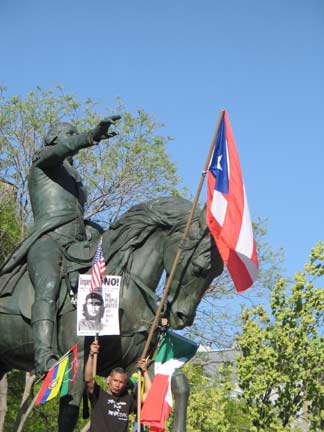

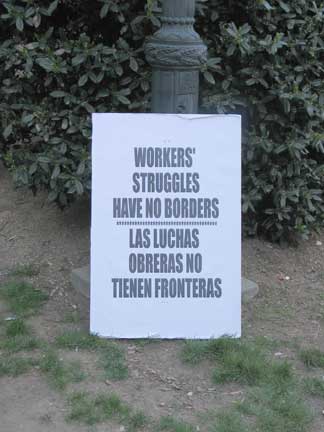

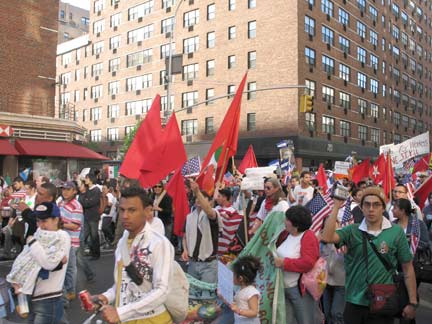
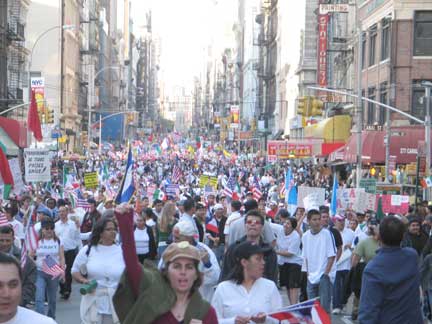

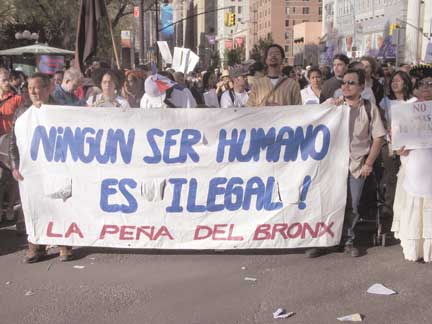

Thursday, May 04, 2006
More May Day Celebration in Iran


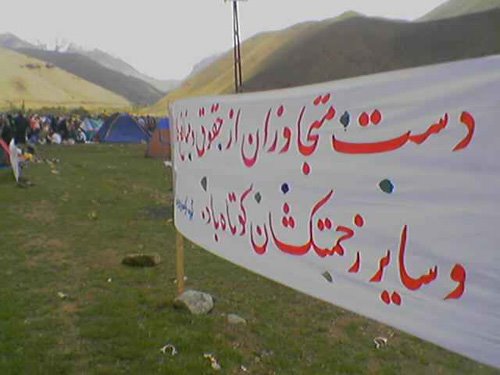 Aggressors, keep your hands off workers' rights and the rights of other toiling masses
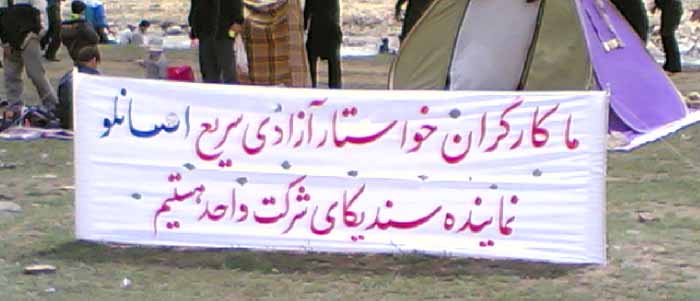 We workers demand the immediate release of Osanloo, representative of the bus workers union
 We workers demand that our right to strike to be recognized
 Pictures from May Day celebration by auto, steel, and bus workers near Tehran
Workers take control of the government sponsored May Day rally In Tehran, Iran
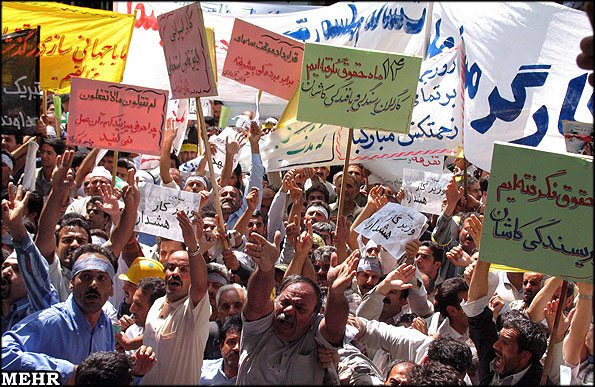 Textile workers from of Kashan:
We have not received our salaries for the last 14 months
 Temporary contract must be abrogated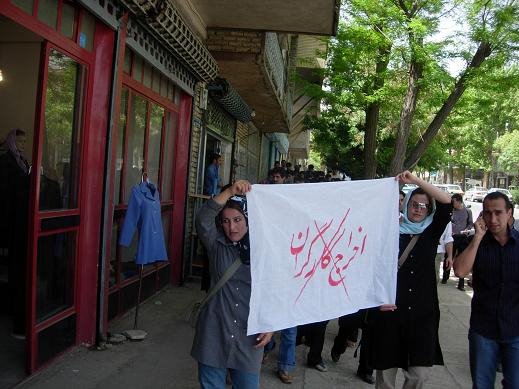
No to firing workers

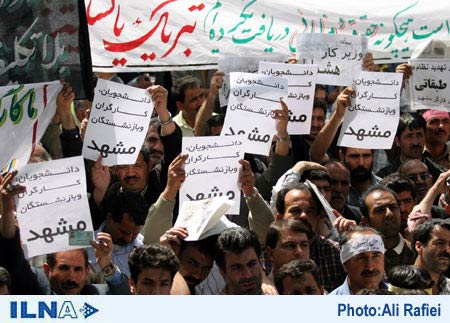 Students, workers, and retirees from Mashhad
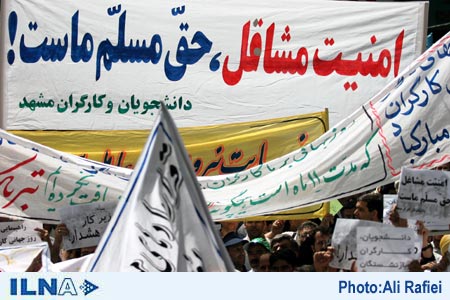 Students and workers from Mashhad: Job security is our right
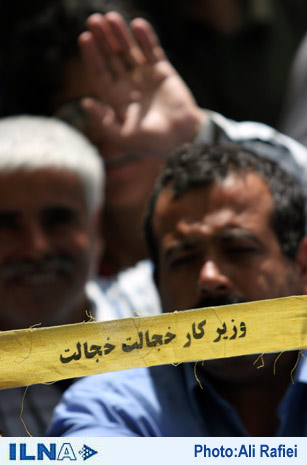 Labor minister, shame, shame
 Freedom and Equality is Our Human Right!
A report on May Day celebration in Tehran, Iran
by Mahmood Ketanchi
May 04, 2006
As many Iranian workers prepared to celebrate May 1st, International Labor Day, House of Labor, a pro Islamic government organization, called for a labor rally in front of the former US Embassy in Tehran. According to different sources, 8,000 to 10,000 workers participated in the rally. In addition to workers from Tehran, many came with buses from from various cities and provinces, such as, Ghazvin, Qom, Ghilan, Kashan, Hamadan, Karaj, Damghan, Mashhad, etc.
The organizers of the rally attempted in vain to turn the May Day gathering into a show of support for the Islamic regime and Iran's nuclear program. Even though the rally was carefully orchestrated to benefit the Islamic regime and provide it with some propaganda , participating workers from the very start took control of the event.
Alireza Mahjoob and Ali Rabii, the leaders of the House of Labor, praised Iran's nuclear achievements and policies of the government. In their speech, they also condemned the cartoons of Muhammad as a western conspiracy against Islam. However, many participants became very angry at the speeches. They said they came to the rally to speak about their conditions and plights, but instead they were being lectured about Iran's nuclear achievements.
The protesting workers called the speakers “traitors” and “government men.” They chanted “workers representative must come from amid the workers.” The noise and the chanting was so loud that no one could hear the speakers.
Some workers complained that they were forced to come to the rally and others said that the organizers of the rally made workers promise that they would not violate the plans for the rally. They also complained that the House of Labor tried to hand pick workers for the rally.
As tension grew among the participants, several thousand workers broke away from the rally and began to march towards Tehran University. But security forces intervened; they surrounded workers and threatened them with violence and arrest. Under police pressure, protesting workers were forced disperse.
The chants of the workers included:
Bread, housing, and freedom are our rights!
Salary increase above inflation!
Freedom and Equality are our rights!
Capitalist government, shame, shame!
Look at France, think about our lives!
Let go of nuclear power, think of our lives!
worker, student, and teachers, unity, unity!
Strike and organization are our rights!
Political prisoners must be freed!
Labor minster, resign, resign!
When some workers were arrested by the security forces, other workers booed them and chanted “security forces, shame, shame.” As a result everyone was released.
It is important to point out that last year, the House of Labor tried to turn May Day celebration into a presidential campaign for Hashami Rafsanjani, one the top mullahs in Iran. But workers disrupted the rally and prevented Rafsanjani from coming to the event.
Subscribe to:
Posts (Atom)